Showing posts with label aliens. Show all posts

Wednesday, February 17, 2021

The Sun Stares Back

It's a tapeworm! I swear to Christ it's a fucking cosmic tapeworm! Listen! It's 27,003.8 km long, it lives in the sun, it returns every 76 years 4 months 2 weeks after feeding, it
[DATA EXPUNGED]
You'll just have to wait, doc.

SCP-1682

Starcages are enigmatic megastructures found in several systems. They're alien in origin, and at least 3 million years old.

True to their name, they are found around stars. The star is always a G-class yellow sun - some stars surrounded by starcages have evidence of massive starlifting operations to make them G-class. The bygone alien culture which built these vast constructions (tentatively dubbed the Starcage-Building Culture Group by xenoarchaeologists) evidently took great pains to make starcages happen.

The cage has a swarm architecture. Tens of thousands of flat, pentagonal statites, each the size of a small continent and arrayed with respect to the others in a fractalic dodecahedral pattern, hover suspended in the star's chromosphere, pushed upwards by the pressure of solar wind. Electromagnetic spectrum imaging reveals an intricate network of magnetic flux lines bound into tight arcs, directed through the statites, making up a colossal polyhedral lattice of energy. Electromagnetic force forms a constricting cage around the star, confining its vast eruptions.

Starcages aren't energy collectors. They aren't even protective structures, set up against solar flares. They are animal pens.

coronal mass ejection

It's not entirely clear what animal lives inside these stars. Based on what little is visible of them, they're probably shaped like worms. Sometimes, their bodies arc out of the star's nuclear atmosphere, a Loch Ness monster of blinding white plasma. The very smallest of them are the size of the continental United States. The largest could wind their body at least one and a half times around the Earth.

When uncaged, they tend to migrate. They launch themselves out of their home star, achieve solar escape velocity, and spin a thin, hard cocoon from space dust they gather via their innate magnetic field. They travel slower than light, coasting for decades or centuries in complete dormancy, until they reach another G-type star to colonize.

coronal rain

Each star surrounded by a starcage contains 5d100 sunswimmers. Don't stat them. They are a narrative problem. Getting directly attacked by a sunswimmer is like slamming into a goodly-sized planetoid, and no spaceship-sized weaponry can even concievably harm one. An encounter with a sunswimmer is an open-ended scenario unto itself. The players will have to figure out how to deal with it themselves.

If you encounter them in space, odds are they're cocooned and either in transit or dormant. They might be woken. 

If you encounter them in their natural habitat, your spaceship is inside a star, and mechanical questions are moot anyway.

sunspot
4 adventure hooks
  1. A scientific institute contracts the players to drop a disposable probe into a nearby star so they can figure out what's inside the starcage. The star is a popular pilgrimage site of the Solarian Church. When they learn of the players' mission, the devout Solarians accompanying them on their trip desperately try to stop the heresy, first by impassioned pleading, then by violence.
  2. A derelict starcage statite is found drifting in a close orbit around an uncaged star in a newly-colonized system. This is a megadungeon; statites are huge. Play it either as cosmic horror, the exploration of the ruins of near-incomprehensible precursors, or as an alien death trap, with reckless treasure hunters being massacred by three million year old defense systems. Keep in mind that this colossal monolith is the Starcager equivalent of a fence post.
  3. The Company's latest job for the players is to tow an entire asteroid to a "processing station" for disassembly. The asteroid is actually the cocoon of a dormant sunswimmer, and the processing station is a corporate research facility. This information is above the players' pay grade.
  4. An uncaged star is undergoing extreme starquakes and stellar eruptions as a sunswimmer inside prepares for its migration launch. A solar research station calls for help as its heat shields begin to fail. Can you reach and rescue them before the vast creature emerges into space?
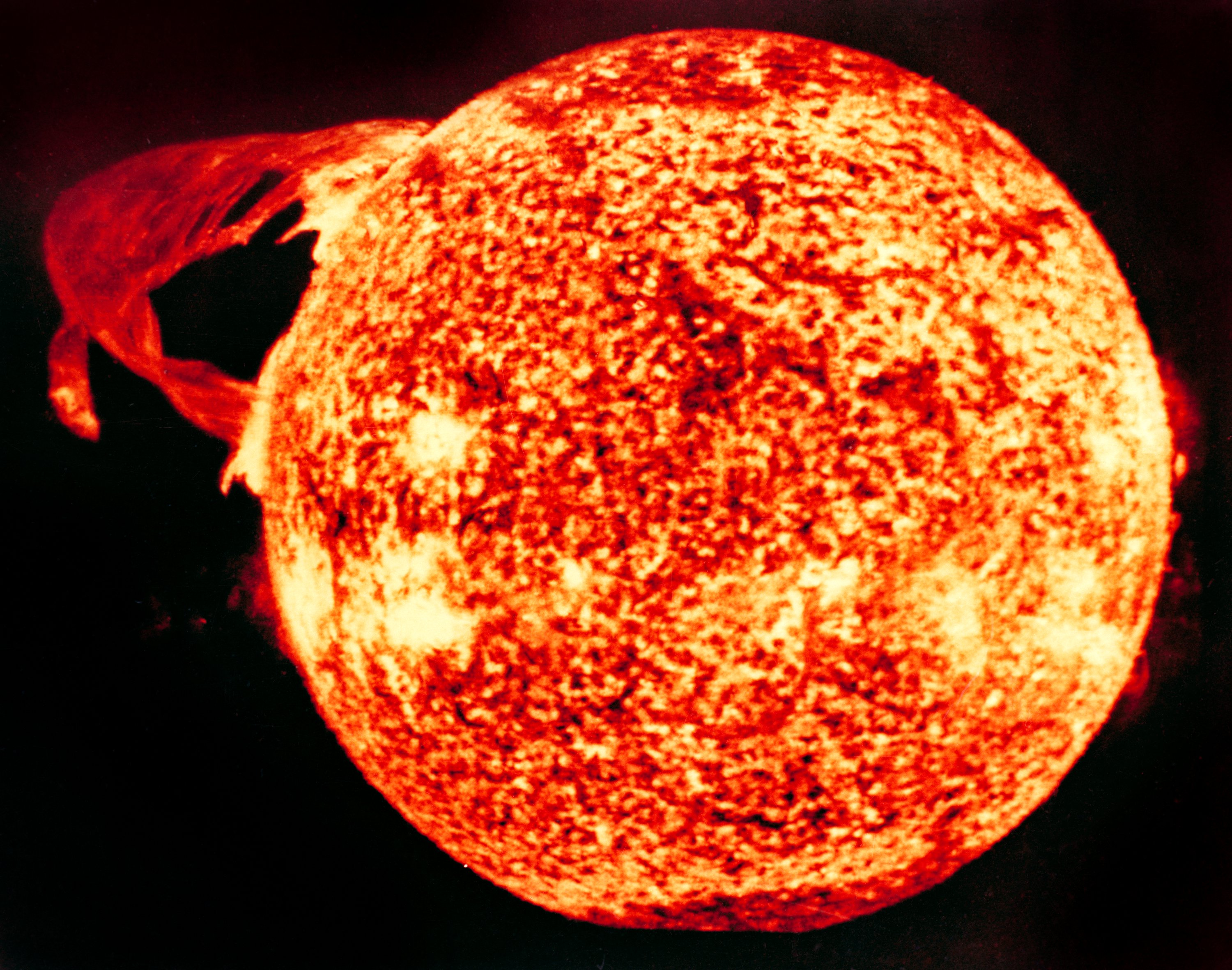
oh yeah the sun just occasionally does shit like this, don't worry about it lol


Wednesday, December 30, 2020

1d10 organisms from Curie's World

This is a list of 10 different alien creatures you might encounter during your work assignment on the hellish, radioactive garden planet known as Curie's World. This is only a very narrow slice of the planet's staggering biodiversity, but hopefully enough to get your gears turning.
  1. Nuke Tree and Elephant's Foot Tree: Common treelike organisms feeding on the violent radiation outbursts of Curie's star. Nuke trees are tall, slender and their trunks are unnervingly smooth. They tend to form massive forests, fighting for the lethal sun"light" with their melanistic, radiation-collecting fronds. Elephant's Foot Trees, in contrast, are gnarled and bloated, and tend to stand solitary in nuke tree forests. Their roots secrete toxins that kill other elephant's foot tree saplings in the vicinity, thereby ensuring that they have a local monopoly on the specific cocktail of nutrients they require.
  2. Plainsland Scrammer (C 35, I 30, S 55, H (2) 25; kick: 2d10 and Body save or be flung away): Open area grazers occuring in herds of 4d10 individuals, named for their fast run. While running, they fold their middle pair of legs up against their belly, with the scrammers leading the herd's charge using their sidelegs to kick things out of the way. They are suspicious of every movement, responding with threat displays and fleeing if necessary. They are a favored prey of the greater chernobog.
  3. Greater Chernobog (C 65, I 55, S 30, H (4)30; scything claws: 3d10, digestive syringe: 2d10 damage and 1d10 Body save decrease): The apex predator of the area where Company extraction works are active, a horse-sized, black-carapaced myriapod-thing with powerful pillar-like legs and wicked sickle-shaped claws on its foremost pair of limbs. It is an ambush predator lunging out from between nuke trees or tall sootgrass to strike down prey. It cannot sustain long bursts of running, and will usually give up on prey it cannot run down within a two or three combat rounds. Felled prey is pumped full of digestive fluids, liquefied and slurped out of its skin. Chernobogs are highly territorial and solitary animals, and indiscriminately attack each other out of mating season.
  4. Black Sarcophagus (C 15, I 0, S 0, H (3) 10; acid spray: 2d10, acid bath: cumulative 1d10 per turn): Sessile organism, shaped like a black bathtub with six petals, lying in wait in nuke tree forests. Once someone or something stumbles into it (Intellect check to notice, Body save to avoid), it snaps tightly shut and begins to fill itself with digestive fluid. A Crisis check of two Strength checks are needed to pry it open, from the inside or the outside. If attacked, it sprays corrosive digestive fluids at its attacker, squealing loudly.
  5. Treetop Tokamak (C 30, I 70, S 45, H (1) 25; throw bulb: 1d10, batter: 2d10, bioluminescent flash: Body save or dizzied): About man-sized, arboreal brachiator with six limbs, each of which can function as an arm or leg, as needed. Named after their squawking call. Tokamaks are highly intelligent pack hunters, employing complicated group tactics, throwing heavy fruiting bulbs from the treetops and disorienting their quarry with dazzling flashes of bioluminescence, before descending on their overwhelmed prey and beating it to death. A tokamak troop usually counts 2d10 individuals; if a few of them are felled, they cut their losses and flee.
  6. Tsar Whaleworm (C 85, I 25, S 15, H (5) 100; fin slap: 1d10 to people or 1d10 MDMG to structures and submarines): Massive, peaceful filter feeders that resemble many-finned giant worms, each the size of a train. Graceful, combed tentacles extend from their mouthparts, scooping up xenoplankton. Whaleworms usually come near the shore in pods of 1d10 individuals, and don't attack unless they're bothered. There's been rumors of the Company sending out armored submarines to try and harpoon one of these massive creatures, but corporate consistently denies this claim.
  7. Trinity Cyst: Named for its trilateral symmetry. Bloated bladder growing from the ground in nuke tree forests, a defensive mechanism against herbivores deployed by certain radiotrophic xenofungi. If stepped on, it bursts with a cloud of poisonous powder - the powder is biochemically incompatible with humans, but incidentally it is also horribly radioactive and sticks to everything. Intellect check to notice the cyst, Body save to dive out of the cloud's way.
  8. Whistling Stalker (C 45, I 65, S 75, H (3) 30; claw spurs: 1d10): Large, agile flying creature with two pairs of wings - the first pair, broad and sheet-like, enables gliding and powerful upward flaps, while the second, small and delta-shaped, facilitates fast air propulsion and aerial maneuvers. The stalker spends most of its time gliding on its forewings, surveying the area for suitable prey (like a juvenile scrammer or a lost tokamak, generally roughly human-sized things). It dives out of the air to attack and attempts to grab its prey (Combat vs. Body save opposed roll), then ascend into the air and drop it onto an exposed rock surface (Body save or die).
  9. Tumbler-Snapper (C 20, I 35, S 60, H 1; scratch and bite: 1d10, nuke ray: 5d10 and appropriate radiation penalties): A small, ciliated, eight-legged critter that feeds on the fruiting bulbs of local xenoflora, separating out radioactive materials from its food and storing it in a special gland. As a defensive measure, it can trigger criticality in this gland via carefully controlled chemical reactions, and emit a searing burst of radiation. For radiation-resistant Curian predators, this burst is still strong enough to sicken and discourage them from attack; for humans, it causes severe radiation burns and can kill in minutes, even through a hazard suit. The tumbler-snapper has only one shot at this before it has to replenish its fuel gland again.
  10. Three-mile Mycelium: Enormous network of radiotrophic xenofungus that reaches deep into the earth, feeding on the radiation output of the planet's ubiquitous natural nuclear reactor deposits while keeping a symbiotic link with the nuke tree forests above. The mycelium exhibits a cold, vast fungal intellect - not exactly sapient, but intelligent. It wants the forest to be nice and healthy, so it can keep getting nutrients for it. To this end, it subtly manipulates local wildlife through subtle physical and chemical means - areas with an active mycelium might see worse harvests or more wild animal attacks on planetside workers, and the Company may decide it's better worth sending its workforce elsewhere.

The Troubleshooter Corps

A common assumption of Mothership games is that the PCs are bystanders. Whatever horrid shit happens to them, it's not because they spec...