Showing posts with label planetology. Show all posts

Tuesday, May 25, 2021

The Planet that Never Sleeps: Earth for Mothership

In Los Ageless, the waves they never break
They build and build until you don't have no escape
But how can I leave? 
I just follow my hood to the sea, go to sleep

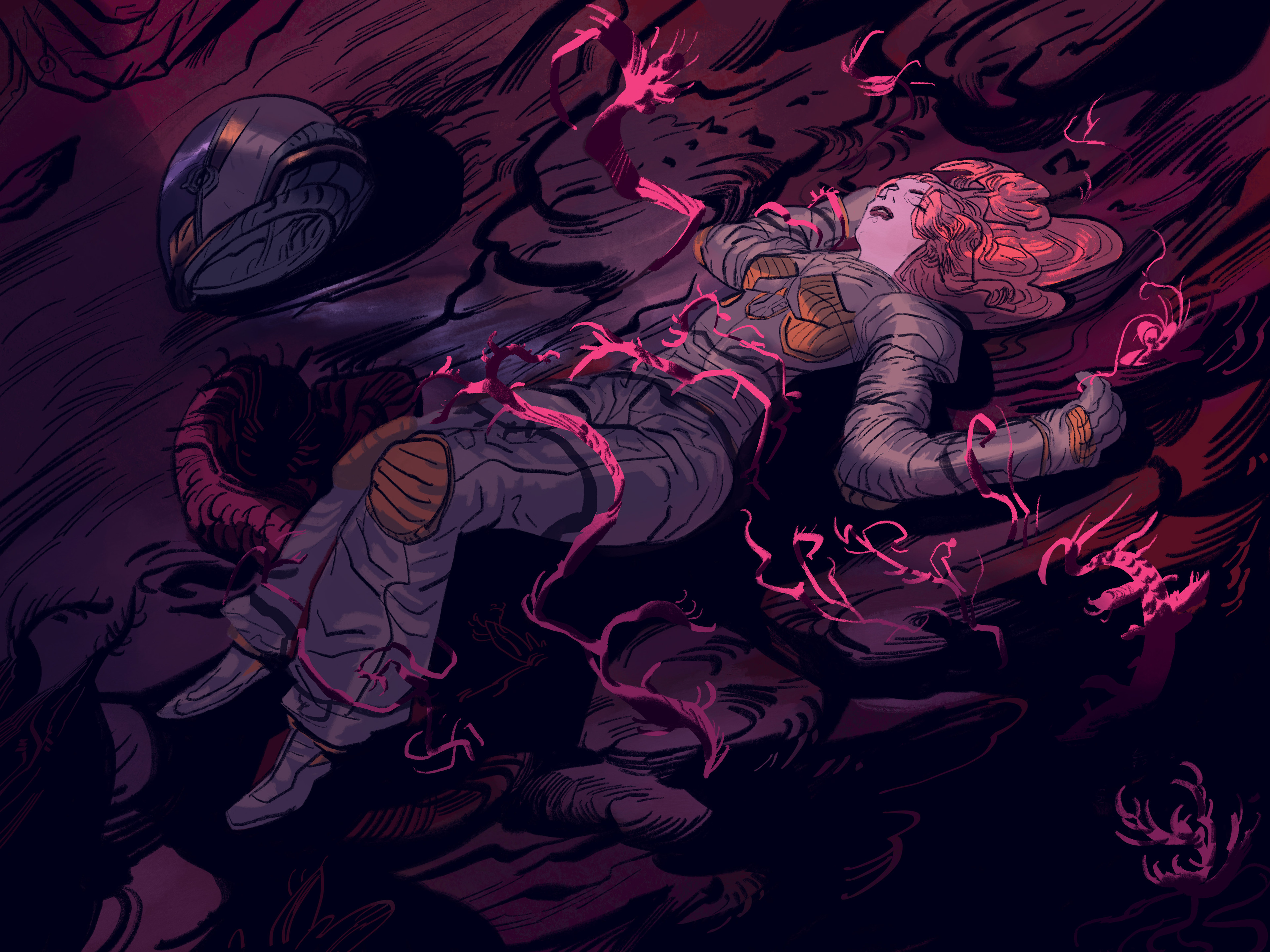
a.k.a. "your players asked what's going on with Earth while they're out on the Rim being torn to pieces by space demons".

The Fifth Element
The Blue Marble. The Pale Blue Dot. Home.

Earth.

Cramped, polluted, and teeming with people, the heart of mankind still beats. Slowly, laboriously.

With 27 billion inhabitants and a vastly inefficient global economy straining the ecosphere of what was once humanity's very own garden planet, Earth is wracked by squalor, natural disasters and government repression. The average Terran lives off of a measly federal welfare (most jobs having been automated long ago), has never eaten anything that wasn't synthesized from genetically modified algae, keeps a tsunami survival kit under the bunk of their tiny assembly line hab-block, and is told every day how privileged they are to live in humanity's cradle.

artist: Jon Hrubesch

The unflattering picture of Earth changes drastically, of course, if you happen to be one of the mega-rich. Here, unimaginable luxuries are available if you can pay - the most prized of which is Mother Nature itself. With the planet's natural areas rapidly dwindling, the Earth Federal Governing Authority has placed astronomical admission fees on entering its natural reserve areas, the so-called Green Zones, ostensibly to cover the increasing costs of reversing ecological collapse. Only the richest inhabitants of Earth can afford to view the remaining few patches of nature on the mother planet, congratulating themselves on their charitable works as they funnel billions of credits into what have been essentially reduced to private parks for the 0.001%.

Elite: Dangerous
Officially, Earth is the capital planet of all human-controlled territories across civilized space. In actuality, the grip of the Terran government hardly reaches beyond corespace - it is simply impossible to keep such a vast volume of space entirely under direct control. In the Middle Regions, as jumps become longer and riskier, its authority becomes faltering and tenuous, and the megacorporations increasingly take up the slack of power and control. In rimspace, Terran authority is entirely nominal. There are corpostates and independent colonies out there which the Federation is simply logistically incapable to reach and subjugate.

All of this, of course, is swept under the rug in Terran media, where glossy megastars and ad campaigns showcase the far reach of Earth to its dejected citizens. TV lotteries promise vacation trips to faraway planets, brought to heel by Terran manifest destiny. Talk show hosts pose with corporate dignitaries and rimspace colony leaders. VR films, free television programming, news feeds all regurgitate steady, uninterrupted prolefeed - lurid, sex-obsessed commercials, old-corporate propaganda, and never-ending soap operas about the lives of important people.

As the oldest economy in the human sphere, many of the most ancient megacorps are heaquartered here - some ossified and dynastic, some fragmented and self-consuming. These fossilized old-corps constantly vie for control over space with the upstart neocorps that sprung up out in the colonies, as well as each other, perverting every political institution supposedly representing all humanity into pieces in their great game. Earth's governance is a tangle of backroom politics and corporate interests puppeteering state offices, with a thin gauze of representative democracy painted on top.

Despite being the most densely urbanized planet in human-inhabited space by a large margin, Earth exports almost nothing, save for sleazy and propagandistic entertainment, colonial arrogance and gunboat diplomacy. Most of its economic production is tied up in keeping its largely unemployed population fed and housed, by the most generous definitions of both "fed" and "housed". The majority of the rest goes to accommodating pilgrims and tourists, 552 million of whom visit the planet's incredibly manufactured open-air museums - corp-friendly, sterilized versions of old Earth settlements - each year.

Judge Dredd: Mega-City Two
1d5 adventure hooks on Earth
  1. An especially tenacious breed of mind-altering alien parasite infected the water filtration systems of a mega-racktower, carried planetside by a gaggle of tourists slumming it with the hab-blockers. Go in there and smoke the little fuckers out before they decrease the revenue growth of the water treatment company too much.
  2. There's a new drug on the streets - go check it out and see if the boss can get in on the trade too. Secretly, the drug is manufactured and distributed by SynThac LLC, and causes addicts to commit false-flag eco-terrorist attacks, with corporate police ready to swoop in and save the day.
  3. A colossal organism crawled out of the Atlantic Ocean and was promptly gunned down by the point defense systems at Manila. Corpse-diving becomes a veritable gold rush - perhaps you can make it big selling genome samples, or even kaiju caviar!
  4. The brand new SweetDreams chips (double the sleep in half the time!) are the latest fad in neuro-implant chips... but sleepers suddenly begin to receive strange and disturbing dreams through the implants, urging them to return to apedom.
  5. Through a miraculous stroke of luck, you all won a dinner with Medusa McClyde, the queen of crackle music! Meet the idol in the five-star restaurant atop the Kampala Space Elevator, and try to survive the night amid ever-present media surveillance, trigger-happy bodyguards, and the bizarre and horrific proclivities of Ms. McClyde herself.
Hong Kong


Monday, May 17, 2021

One Million Planets

This post originally started off as an attempt to reorganize the notoriously byzantine and inconsistent NoLWoCS planetary classification system from one of my favorite science fiction universes, Orion's Arm. I gave up about a third of my way in; it just has too many bizarre, obtuse baked-in assumptions to be salvageable.

So instead I wrote a d10-based planet generator.

If you need to populate a planetary system fast, just roll up a few of these babies and put them in a sensible order from their primary. It's not a complete system, and doesn't generate particularly bizarre configurations (such as Curie's World), preferring instead to stick close to the most commonly known varieties of planets. Still, it does produce some pretty interesting planets with which you can populate the heavens.

All art in this post is by Adam Makarenko.

HOW TO USE THIS POST

This is a series of roll tables intended for relatively quickly generating a solar system or just randomly producing a single planet. You are, of course, free to ignore any result you don't like. Now that I put it out here, it's yours to use however you wish.

Using the tables is pretty simple:

  1. Roll Basic Characteristics (class and orbital parameters).
  2. Go to the Class tables of your planet and roll Subtype and Satellites.
  3. If your planet has large moons, go to the Planetoid Class tables and roll Subtype for each.
  4. If your planet is an Oasis or Superhabitable planet, go to the Oasis Planets table and roll Subtype.
Easy as that.

BASIC CHARACTERISTICS

Roll Class

  • 1-2: Planetoid (dwarf planets and large moons)
  • 3-4: Terrestrial (rocky planets)
  • 5-6: Superterrestrial (super-Earths and ocean planets)
  • 7-8: Neptunian (ice giants)
  • 9-10: Jovian (gas giants)

Roll Orbit

  • 1-5: Normal.
  • 6: Skolian. Extreme axial tilt, at least 70 degrees. Rather than spinning like a top, the planet rolls on its side like a barrel.
  • 7: Tidally locked. One side always facing its primary, the other always facing away. May be halfway a scorched desert, halfway an icy waste, or more turbulent and moderate if a thick atmosphere is present to disperse the heat. It might be unchanged, if it's far away enough or if its primary is cold to begin with.
  • 8: Spin-orbit resonance. Rotates exactly x times for every y revolutions around its primary. (Example: Mercury is in a 3:2 spin-orbit resonance around the Sun - 3 rotations for every 2 revolutions.) The primary may occasionally appear to move backwards in its sky. 
  • 9: Retrograde. Rotates in the opposite direction it orbits, or orbits in the opposite direction as other bodies in the same system. May have been captured into orbit from somewhere else.
  • 10: Eccentric. Extremely oval orbit; shoots out far away from its primary on its apoapsis, or zips very close by it on its periapsis. Might have extreme temperature variations.

PLANETOID CLASS

Subtype

  • 1-2: Barren. Sterile rock pockmarked by craters, little to no atmosphere. Water ice deposits in craters of eternal darkness.
  • 3-4: Kuiperian. Icy surface dusted with reddish-brown tholins. Tenuous atmosphere of usually nitrogen, prone to freezing solid. May have a subsurface ocean.
  • 5-6: Cryonic. Covered in a thick layer of ice (water, CO2, ammonia, methane etc.). May hide a subsurface ocean underneath (water, water-ammonia-mixture, ethyl-alcohol etc.). May not have an ocean: icy mantle surrounding a rocky core, an even mixture of ice and rock, etc.
  • 7-8: Cryovolcanic. Cold and extremely tectonically active, wracked by constant earthquakes and cryovolcano eruptions. Covered in sulfur frost layered over water ice.
  • 9: Chthonic. Extremely hot. Highly volcanic, covered in molten lava flows.
  • 10: Oasis. Moderate-sized, complex atmosphere, extensive bodies of liquid across the surface. Can support complex, mature ecosystems. (Roll on Oasis table.)

Satellites

  • 1-2: None.
  • 3-4: 1d10 small irregular moons.
  • 5-6: Huge tidally locked moon, binary planetoid system. (Roll on Planetoid table.)
  • 7-8: Faint ring system.
  • 9-10: Roll twice.

TERRESTRIAL CLASS

Subtype

  • 1-2: Barren. Sterile rock pockmarked by craters, little to no atmosphere. Water ice deposits in craters of eternal darkness.
  • 3-4: Cytherean. Extremely dense, hot atmosphere, highly acidic or alkaline. May or may not have surface liquid.
  • 5-6: Martian. Dry, irradiated, usually cold desert. Sparse, unbreathable atmosphere. May have had large bodies of water once.
  • 7: Chthonic. Extremely hot. Highly volcanic, covered in molten lava flows. Might be a young rocky planet, the core of a dead gas giant, or simply too close to its primary.
  • 8: Cryonic. Covered in a thick layer of ice (water, CO2, ammonia, methane etc.). May hide a subsurface ocean underneath (water, water-ammonia-mixture, ethyl-alcohol etc.). May not have an ocean: icy mantle surrounding a rocky core, an even mixture of ice and rock, etc.
  • 9: Cryovolcanic. Cold and extremely tectonically active, wracked by constant earthquakes and cryovolcano eruptions. Covered in sulfur frost layered over water ice.
  • 10: Oasis. Moderate-sized, complex atmosphere, extensive bodies of liquid across the surface. Can support complex, mature ecosystems. (Roll on Oasis table.)

Satellites

  • 1-2: None.
  • 3-4: 1d5 small irregular moons.
  • 5-6: One huge moon (roll on Planetoid table).
  • 7-8: Rocky or icy ring system.
  • 9-10: Roll twice.

SUPERTERRESTRIAL CLASS

Subtype
  • 1-3: Pelagic. Covered entirely or almost entirely in oceans, up to 15-20 km deep. May support life, microbial or more complex.
  • 4-6: Abyssal. 100% ocean cover, up to 50 km deep. Sea floor covered in a thick layer of high-pressure, crystalline ice-VII. Mineral-poor seas ill-suited to bearing life.
  • 7-9: Mini-Neptune. Extremely deep oceans of supercritical water enveloped by a thick hydrogen-helium atmosphere. Transitory stage between ocean planet and ice giant. The largest type of super-Earth.
  • 10: Superhabitable. Thick atmosphere, largely even mixture of small continents and shallow oceans. Even temperature. Extremely conducive to life, even more so than Terrestrial Oasis planets. Can support practically rainforest-level biodiversity on its entire surface. (Roll on Oasis table.)

Satellites (roll twice)

  • 1-2: None.
  • 3-4: A multitude small irregular moons.
  • 5-6: 1d5 large moons (roll on the Planetoid table).
  • 7-8: Rocky or icy ring system.
  • 9-10: Roll thrice.

NEPTUNIAN CLASS

Subtype

  • 1-6: Cryo-Neptune. Cold, lonely, azure or greenish planet located far beyond the snow line, with a hydrogen-helium atmosphere rich in volatile ices - ammonia, methane, and so forth. May cross into the Kuiper belt.
  • 7-9: Hot Neptune. Hellishly hot atmosphere, may be in the process of evaporating away. Gas envelope contains exotic volatiles or refractory materials. Can be any number of colors due to its exotic chemistry; may also glow red from thermal radiation.
  • 10: Helium planet. So close to its primary the hydrogen evaporated out of its atmosphere, leaving only an envelope of pure helium. White or light grey, and cataclysmically hot.

Satellites (roll twice)

  • 1-2: A multitude of small irregular moons.
  • 3-4: 1d5 large moons (roll on the Planetoid table).
  • 5-6: Spectacular ring system.
  • 7-8: 1 large Oasis moon (roll on the Oasis table).
  • 9-10: Roll thrice.

JOVIAN CLASS

Subtype

  • 1-2: Cryo-Jovian. The coldest type, brooding beyond the snow line. Ammonia clouds lend it a yellowish, orange or reddish color.
  • 3-4: Hydro-Jovian. Warm, orbits in the habitable zone. Clouds of dazzling white water vapor.
  • 5-6: Azuri-Jovian. Much too warm for clouds to form. Clear, blue, featureless orb.
  • 7-8: Hot Jupiter. Cloud decks of alkali metals, such as sodium. Dark, grey, hellishly hot.
  • 9-10: Ultra-hot Jupiter. The very hottest gas giants, closest to their stars. Clouds of pure iron and silicates. Hot enough to give off a dim red glow.

Satellites (roll twice)

  • 1-2: A multitude of small irregular moons.
  • 3-4: 1d5 large moons (roll on the Planetoid table).
  • 5-6: Spectacular ring system.
  • 7-8: 1 large Oasis moon (roll on the Oasis table).
  • 9-10: Roll thrice.

OASIS PLANETS

Roll here if you got an Oasis or Superhabitable-type planet from either the Planetoid, Terrestrial or Superterrestrial table.

Subtype
  • 1-4: Gaian. Silicate crust, oceans of water, oxygen-nitrogen atmosphere. Familiar to humans.
  • 5-6: Methanogenic. Water-ice crust, oceans of liquid hydrocarbons, nitrogen atmosphere with a colorful organonitrogen haze.
  • 7: Ammonian. Silicate crust, oceans of liquid ammonia with dissolved alkali metals. Cold, nitrogen-nitrous oxide atmosphere. 
  • 8: Vitriolic. Silicate crust, oceans of pure sulfuric acid. Extremely hot oxygen-nitrogen-CO2-sulfuric acid atmosphere.
  • 9: Halogenic. Silicate crust, oceans of water mixed with hydrochloric or hydrofluoric acid. Oxygen-nitrogen-chlorine/fluorine atmosphere. Acid rains.
  • 10: Carbonian. Graphite crust, diamond mantle, oceans of tarry hydrocarbons, carbon monoxide or carbon dioxide atmosphere with choking carbon smog.

Monday, January 25, 2021

Clytemnestra Colony

Clytemnestra is a supercytherean planet located in rim space. "Supercytherean" means it's Venus-like and somewhat larger than Earth. Like all Venus-type planets, this one too is an acidic pressure-cooker: dry, dim and unbearably hot, with an atmosphere dense enough to smash interplanetary probes into aluminum cans, all wreathed in an eerie veil of pale yellow clouds, composed of pure sulfuric acid. Beneath the clouds, an unforgiving chaos terrain of dark basaltic rock is concealed.

That's how it used to look, at least.

Planets by Perigee, a subsidiary of the illustrious megascale engineering megacorp known as the Perigee Corporation, has been hard at work terraforming Clytemnestra for the past three hundred years. Terraforming Venus-types is hard, slow, thankless work even by the standards of planetary engineering, generally considered to not worth the hassle compared to simply establishing cloud-city type colonies, but Perigee has a reputation for extravagant gigaprojects. Atmosphere extraction, temperature reduction, reversing the runaway greenhouse effect - the most talented planetary engineers of eight generations have worked tirelessly to turn this desolate world into an Earthlike paradise. Clytemnestra is the crown jewel of Perigee's terraforming business, a proof of the Corporation's groundbreaking and high-quality craftsmanship that can tame even the most hostile planets.

Also, it is failing.

Wednesday, December 30, 2020

Curie's World

Do you want to give your players a Company job that actually pays well for once? Sure, but they'll have to suffer for it.
Welcome to Curie's World, one of the worst hellholes a teamster could possibly find themselves in.
[Content warning: cancer, body dysmorphia, psychological abuse.]
At first glance, Curie's World doesn't seem all that bad. It's a rocky planet slightly bigger than the Earth, with continents, seas and a thick, turbulent atmosphere. A balmy average temperature of 23°C (despite its distance from its dim red dwarf primary) and a surface gravity of just 1.1 g make the planet pleasantly familiar to Earthers, while its low axial tilt and relatively ineccentric orbit means there are no wildly changing seasons. Much of the planet is covered in warm, shallow seas. The atmosphere, while quite vaporous and containing trace amounts of certain poisonous gases, is nitrogen-oxygen based, richer in oxygen than Earth, and breathable as long as said poisonous gases are filtered out beforehand (a relatively simple task). The planet bears rich, thriving life. Sure, the surface may be a little dim and foggy, but still very comfortable as far as planets go. By all counts, Curie's World should be an ideal colony.
So what's the catch?
Natural nuclear fission reactors are geological formations composed of a uranium deposit, rich in fissile ²³⁵U, which becomes inundated in groundwater. The groundwater acts as a neutron moderator and enables the deposit to undergo a self-sustaining chain reaction. When it reaches criticality, the reactor soon raises temperatures by a few hundred degrees, boiling away the groundwater, which stops the chain reaction. Once the reactor cools off, groundwater trickles back into the deposit, and the cycle starts again.
On Earth, there is only one known site with natural nuclear reactors. It is located in Oklo, Gabon: a complex of 16 reactors which ran for a few hundred thousand years approximately 1.7 billion years ago, depleting 5 tons of uranium oxide and producing an output of about 100 kW thermal energy in the process. A reactor cycle lasted about 3 hours, with 30 minutes of criticality followed by 2 hours and 30 minutes of cooldown. 
Reactor 15 in Oklo. The yellow stains are uranium oxide ore, the white ones are hydrothermal quartz formed by rapid water circulation.
It is believed that natural nuclear reactors cannot exist on Earth anymore, due to the decay of ²³⁵U content in uranium ore over time.
On Curie's World, planetological survey probes have found 235,354 natural nuclear reactors so far. And counting.
Quirks of the planet's geology cause these unusual features to occur readily. Abundant uranium deposits, richer ²³⁵U content in those deposits, and a much higher percentage of heavy water in the Curian water cycle compared to Earth all make criticality much easier to achieve. Hundreds and hundreds of running fission reactors dot the landscape of this pristine wilderness planet. At night, the seas are illuminated by an eerie blue glow: Cherenkov radiation cast off by undersea reactor sites, which form long geological chains similar to volcanic island chains on Earth.
This lush paradise planet is a radioactive hell. On top of all the dangers of a biodiverse garden planet, the ubiquitous reactor deposits underfoot emit massive amounts of ionizing radiation during their cooldown cycles, when their fission products are not insulated by groundwater. To make it even worse, the primary of Curie's World, a violent, highly metallic flare star, frequently and unpredictably erupts in energetic stellar flares, sending waves of ionizing proton radiation towards the planet. Curie's meager magnetosphere barely deflects any of it. (It does, however, make for some beautiful auroras, even very far away from the poles.) Setting foot on this planet, even in a hazard suit, is a sentence of slow, agonizing death.
In short, the Company is blowing through its Curian workforce like Kleenex.
The Company is interested in Curie's World for a number of reasons. The most obvious is mining. Curie's crust is abundant in uranium ore, which is richer in fissile ²³⁵U than ore found on other planets, saving a whole lot of headaches on uranium enrichment and exotic neutron moderators. Other radioactive ores are also plentiful. What's more, the planet's waters contain a lot of deuterium oxide, or heavy water, which is separated out of Curie's seas by massive, floating water extractor stations, similar to oil drilling rigs in appearance.
The other, less immediately apparent value of this planet is biotechnological research.
Curie's World is a life-bearing planet. Large hosts of alien creatures populate the surface, with underground thermo- and radiotrophic organisms feeding on the heat and radiation output of the nuclear reactors, and tall, treelike radiosynthesizers (the famous "nuke trees") spreading their sooty-black, comb-shaped fronds towards the sky, nourishing themselves on the red dwarf's violent stellar flares like an Earth plant would on light. Upon these primary producers, diverse ecosystems of strange, exotic and often dangerous animals are based - all thriving within an environment that would horrifically and painfully kill an unprotected human being within days.
The solution to this mystery is that Curian organisms have the most powerful DNA repair mechanisms known anywhere, which enables them to avoid instantly dying from super space cancer in the radiation-bathed terribleness that is the environment of Curie's World. The Company's biomedical department is very interested in these mechanisms. Research into how Curian animals make do is projected to yield revolutionary (and eminently patentable) cancer treatments, life-extension techniques, and radiation protection for spacers. They also want to use the radiation-eating xenofungus to make self-healing radiation shields for spaceships, which will definitely not go horribly wrong in any way.
It's a terribly, terribly profitable planet, and the Company is willing to pour immense amounts of money and resources into exploiting it.
1d10 jobs on Curie's World
    1. Maintenance of the uranium mining robots.
    2. Tagging, release and radio tracking of a Greater Chernobog.
    3. Heavy water extraction.
    4. Repairing the heavy water extraction platform.
    5. Processing the washed-ashore corpse of a Tsar Whaleworm.
    6. Geological surveying for new mining sites and underground natural nuclear reactors.
    7. Capturing a live Tumbler-Snapper.
    8. Accompanying important Company scientists who all have better accommodation than you.
    9. Collecting live samples from the Three-mile Mycelium.
    10. Power station maintenance.
So where do the poor sods that are your players factor into all this?
Well the Company first tried sending probes down there, but the intense radiation fried their electronics very, very fast. So they started sending people. People restock themselves on their own, with very little Company input needed, and they cost significantly less to pay than an orbital drone factory.
Thing is, Curie's World is such a shithole that the only way to attract workforce is to actually provide a high pay. Working on this planet is widely regarded as one of the worst jobs out in the black; the only people who willingly take this job are generally utterly desperate, with nothing to lose but everything to gain. The good salary is the only thing that makes it worthwhile for most workers planetside.
Why is this poor teamster here?
    1. Working off a huge debt.
    2. Trying to disappear from a crime syndicate.
    3. Believes they deserve to suffer for something they did.
    4. Incurable, suicidal wanderlust.
    5. Sentenced to hard labor.
    6. Trying to pull their loved ones out of poverty.
    7. Blindly worships the Company.
    8. Rugged individualist prospector.
    9. Genuinely unphased, just here for the money.
    10. Lobotomized Company bioroid.
When you arrive to work on Curie's World, they upload your mind into a simple, utilitarian, mass-produced sleeve. These come in one male and one female variant, and largely look the same - they're made for  work, not for convenience. They stash your original body in a large, efficiently packed cryobay, where it will stay for the duration of your work assignment. They give you a big pack of mildly effective anti-rad pills, a hazard suit, and the tools for your job, put you in a shuttle with fifteen other sleeved workers, and send you down. Then you'll work for a month or two, until you develop severe radiation sickness and die while vomiting and bleeding internally. (Here's some good rules for radiation sickness by Swampgirl.) At this point, a chip implanted into your sleeve's brain stem activates and beams your consciousness back to the Company space station in orbit, where they put you in a new sleeve and send you down again.
This is all a huge expense, but cheaper than sending a new probe every week, and still preferable to leaving the planet unexploited.
What are you bawling about? It wasn't even your real body, you big baby. Do you even remember what your own body feels like anymore? Here, take this neurochemical pill to suppress your crippling body dysmorphia, and get in the shuttle again. Don't you want that cute daughter of yours back in the slums on Omicron Colony to get into that nice university? Then you better get in the shuttle, friend, because that tuition isn't paying itself.

The Troubleshooter Corps

A common assumption of Mothership games is that the PCs are bystanders. Whatever horrid shit happens to them, it's not because they spec...